
10 Signs It's Time to Replace Excel in Dispatch Operations
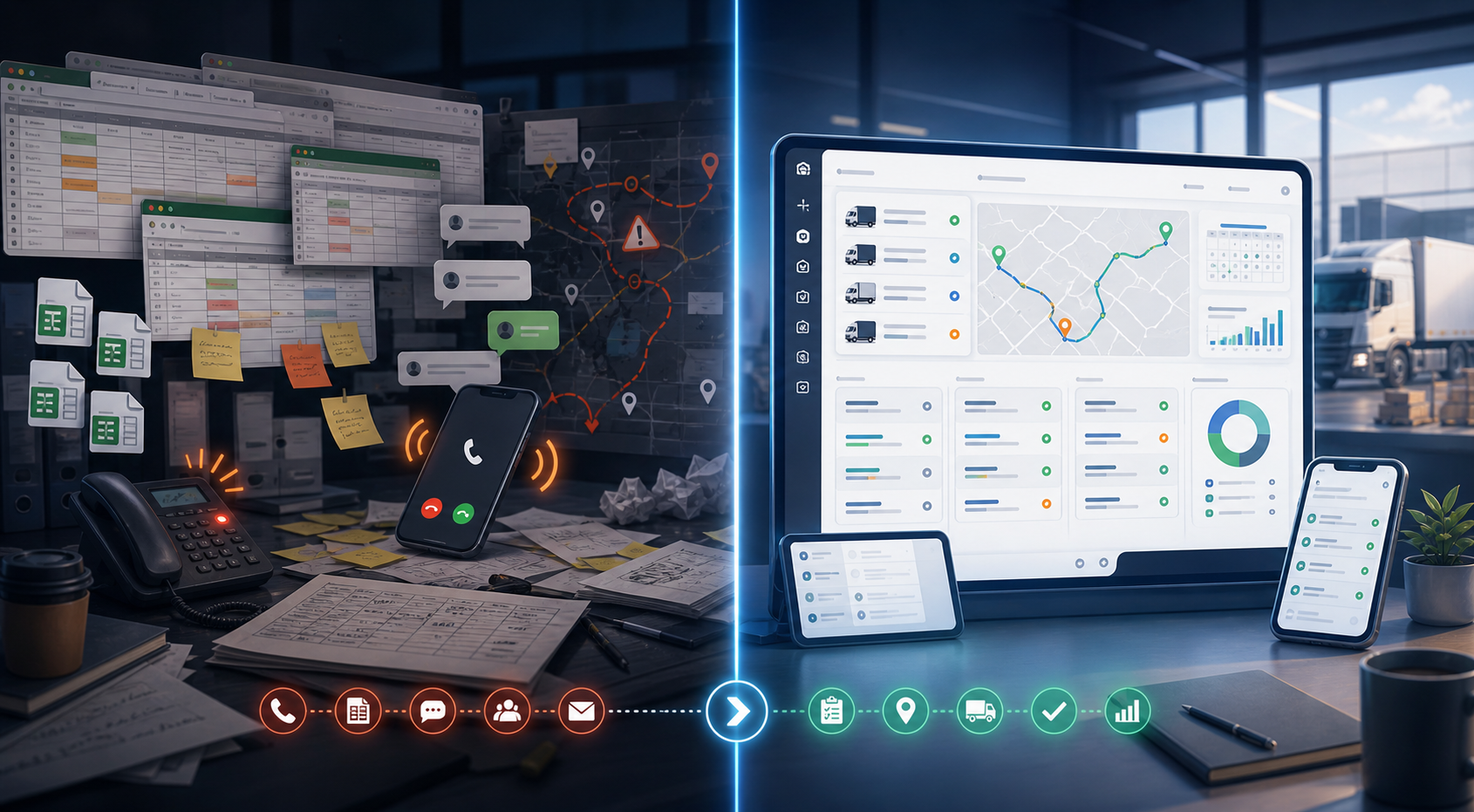
Excel is often the right tool when a company manages a few vehicles and a limited number of daily transport orders. It is flexible, familiar, and requires almost no implementation effort. The problem appears when operations grow. More vehicles, more dispatchers, more customers, and more exceptions gradually turn a spreadsheet into the biggest operational bottleneck.

Michał Błach
Founder & CEO

10 Warning Signs Your Dispatch Process Has Outgrown Excel
None of these signals alone has to mean a full rebuild. But when several of them start appearing at the same time, Excel is no longer just a tool. It becomes the thing that slows the whole operation down.
Only one person knows what's going on
The dispatcher becomes the "system". If that person is absent, nobody really knows which driver is available, which orders are delayed, or which truck has already been assigned.
That is the core problem: operational knowledge lives in people's heads instead of inside a shared process.
The phone never stops ringing
Drivers call. Customers call. Warehouses call. The dispatcher spends the day answering operational questions instead of managing flow.
Questions like "Where is my truck?", "Who has order #412?", or "When will it arrive?" become constant interruptions.
Multiple Excel files exist at the same time
This is one of the clearest warning signs. Dispatch.xlsx becomes Dispatch_NEW.xlsx, then Dispatch_FINAL.xlsx, then Dispatch_FINAL_v2_REAL.xlsx.
Everyone works on something different, and nobody is fully sure which version is correct.
Drivers receive updates through WhatsApp
The issue is not that WhatsApp is a bad tool. The issue is that it becomes the only communication channel for operational changes.
That creates missed messages, wrong addresses, and outdated schedules still circulating after the plan has already changed.
Planning takes hours every morning
What should take ten minutes starts taking two or three hours because the dispatcher manually checks drivers, vehicles, availability, and customer constraints.
Planning time grows because the process depends on cross-checking scattered information by hand.
Nobody can answer simple operational questions
Basic questions suddenly become hard: How many orders were delayed last week? What is the average planning time? What is vehicle utilization? How many orders does each dispatcher handle?
If nobody can answer without manual digging, the process is already too fragmented.
Route changes create chaos
One customer changes a delivery time, and the dispatcher has to manually edit Excel, call the driver, update the warehouse, and inform the customer.
A single operational exception creates a chain of manual coordination because nothing is connected.
Business grows faster than operations
The company responds to growth by hiring more dispatchers instead of improving the dispatch process itself.
That is a classic scaling problem: headcount grows because the workflow does not.
Every dispatcher works differently
One person uses Excel. Another uses Google Sheets. A third keeps notes in a notebook. A fourth tracks things in Outlook.
Without one shared process, quality depends on individual habits instead of system design.
You can't predict tomorrow's workload
You may know what happened yesterday, but you do not know how busy tomorrow will be, which vehicles will become bottlenecks, or where capacity will run out first.
That makes planning reactive instead of operationally controlled.
What To Replace First
Replacing Excel does not always mean building a large, complex system from day one. In many cases, companies can start with the basics and move only the most critical operational steps into a shared workflow first.
Good first building blocks
- A central order list
- Vehicle and driver availability
- Simple status tracking
- Route assignment
- User roles and permissions
- Basic operational reporting
Practical implementation path
Some of these blocks can be based on proven open-source components or lightweight existing tools, then adapted to the actual dispatch workflow instead of forcing the team into a huge one-size-fits-all platform.
Summary
The goal is not to replace Excel with another big system. The goal is to gradually move the most critical parts of dispatch operations into a shared, reliable, and scalable process that dispatchers, drivers, and managers can all trust.
If your team already sees these warning signs, the next step does not have to be a full rebuild. It can start with a focused audit of the current dispatch workflow and a small first version of the platform that solves the biggest operational bottleneck first.
About the author
Michał Błach
Founder & CEO at SP Professionals
Michał helps companies turn manual, fragmented operational workflows into custom software systems built around the way the business actually runs.
With over 10 years of experience in software delivery, enterprise implementations, and workflow design, he focuses on solutions that improve visibility, coordination, and operational efficiency without unnecessary system replacement.
Is dispatch growing faster than the process around it?
We help teams turn operational workarounds into shared systems that are easier to run, easier to scale, and easier to trust.